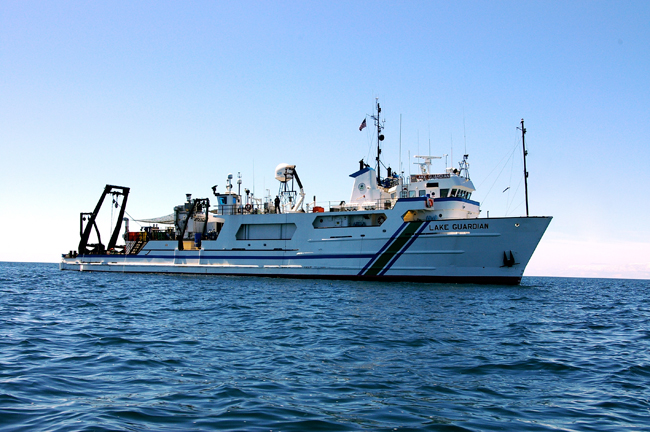
EPA R/V Lake Guardian. Credit: Michael Milligan
Educators Will Spend a Week Aboard EPA Research Vessel on Lake Michigan
Contact:
Nate Drag, New York Sea Grant Great Lakes Literacy Specialist, P: 716-270-2408, E: nwd4@cornell.edu
Kristin TePas, Shipboard Science Immersion, P: 312-886-6224, E: ktepas@illinois.edu
Beth Tucker, Teacher, Tully School District, E: betuck01@gmail.com
Jennifer Crane, Teacher, Ellicottville's Big Picture Learning School, E: jcrane611@gmail.com
Kara Lynn Dunn, NYSG Great Lakes Publicist, P: 315-465-7578, E: aralynn@gisco.net
Buffalo, NY, June 24, 2025 - Science teachers Beth Tucker of the Tully School District in Tully, NY and Jennifer Crane of the Big Picture Learning School in Ellicottville, NY will join Center for Great Lakes Literacy (CGLL) staff and Great Lakes scientists to work aboard an EPA research vessel (R/V) for a week.
Tucker and Crane were selected for the group of 15 educators who will assist the scientists and work with Sea Grant literacy specialists to develop Great Lakes lessons to take back to classrooms.
The July 7-13, 2025 experience aboard the EPA R/V Lake Guardian on Lake Michigan is made possible by a partnership with the EPA Great Lakes National Program Office and NOAA, with funding from the Great Lakes Restoration Initiative. Hosts for the Lake Michigan expedition are CGLL partners Illinois-Indiana Sea Grant and Wisconsin Sea Grant.
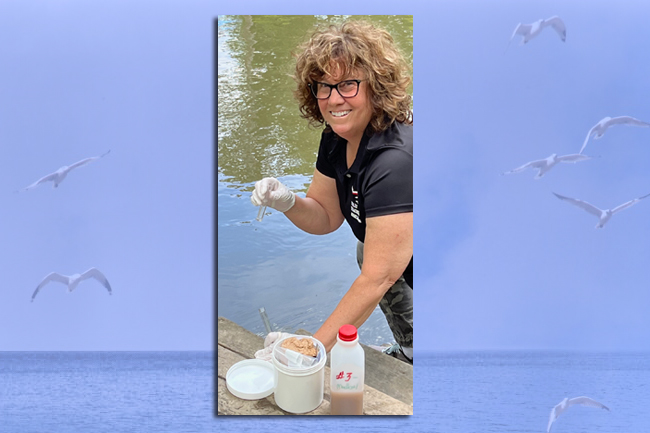
Science teacher Beth Tucker leads a class on the local watershed ecology of Tully School District students. Credit: Beth Tucker
Tucker teaches 7th grade science, high school environmental science, and SUNY ESF in the High School Global Science. She is a New York State Master Teacher with 10 years’ teaching experience, and advisor of the Tully High School Environmental Club.
The Shipboard Science Immersion on Lake Michigan will be a bit of a homecoming for Tucker, who earned her undergraduate degree at Hope College in Holland, Michigan. She is a Master’s degree graduate of both SUNY ESF and Syracuse University.
“I am both familiar with and passionate about the Great Lakes. I’m looking forward to incorporating the scientific data collected on Lake Michigan into my water science curriculum for Lake Ontario. Students benefit from analyzing real-world data, constructing conclusions, and discussing the effects on ecosystems from local and regional to the global environment,” Tucker said.
Tucker is also interested to learn about the underwater archaeology being conducted from the Lake Guardian.
“Many shipwrecks have become ecosystems in and of themselves. This aspect of the experience would fit into our overall aquatic ecosystem discussions and how manmade activities impact that ecosystem,” Tucker notes.
Tucker was selected by the New York State Department of Education to write and edit questions for a state Intermediate Science exam. She used that experience to help colleagues broaden their understanding of State Standards.
Tucker’s students are currently raising Atlantic salmon from eggs for release into the wild as part of an endangered species restoration effort by the OCM BOCES Fish Hatching Program. They also conduct water quality testing as part of field trips to the Tully mudboils.
Tucker has assisted the educational activities of the Onondaga Audubon Society and the Onondaga Lake Conservation Corps.
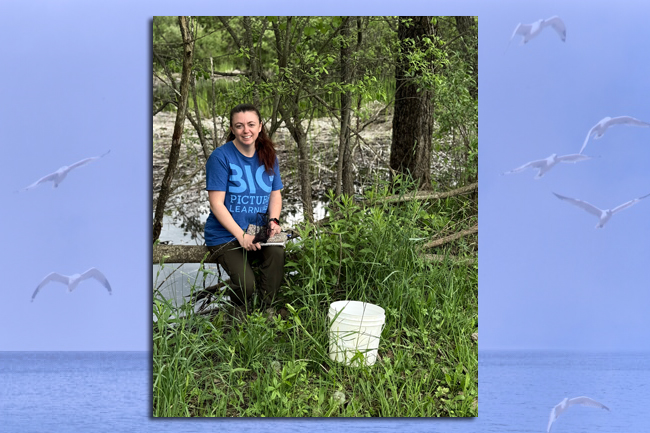
Ellicottville science teacher Jennifer Crane has been selected as one of 15 teachers who will spend a week working aboard the EPA Lake Guardian research vessel on Lake Michigan this summer. Credit: Jennifer Crane
Crane teaches New York State Regents Living Environment, and Earth and Space Science as well as General Science and STEAM classes at the high school level. She has 9 years’ experience teaching grades K-12. The Ellicottville Big Picture Learning is part of the Cattaraugus-Allegany BOCES system.
“I’m excited to work along scientists. My time spent on the Lake Guardian will allow me to develop a Great Lakes-based interdisciplinary program for my students, especially, with my watershed biology class. I look forward to adapting the data we collect on Lake Michigan on studies of Lake Erie and its watershed,” Crane said.
Crane’s own continuing education has included New York Sea Grant workshops on Great Lakes coastal resilience and plankton in the Great Lakes aquatic food web.
“I have a passion for watershed ecology and look forward to sharing my shipboard immersion through Big Picture Learning’s annual conference that draws BPL teachers from across the world and at local outdoor recreation and environmental clean-up events,” Crane said.
Crane is an outdoor hike and white water rafting group leader and serves on the Buffalo Women of Environmental Learning and Leadership (BWELL) Board of Directors. She developed and runs a Buffalo Engineering and Awareness for Minorities Saturday Academy for children.
Crane’s Ellicottville Big Picture Learning students presented the results of their study of bacteria in western New York fresh waters at the May 2025 student research symposium at the University at Buffalo. The students are also raising fish from eggs for release into the wild as part of the Trout Unlimited’s “Trout in the Classroom” program and presented their collected data as part of the online GLOBE (Global Learning and Observations to Benefit the Environment) Student Research Symposium in May 2025.
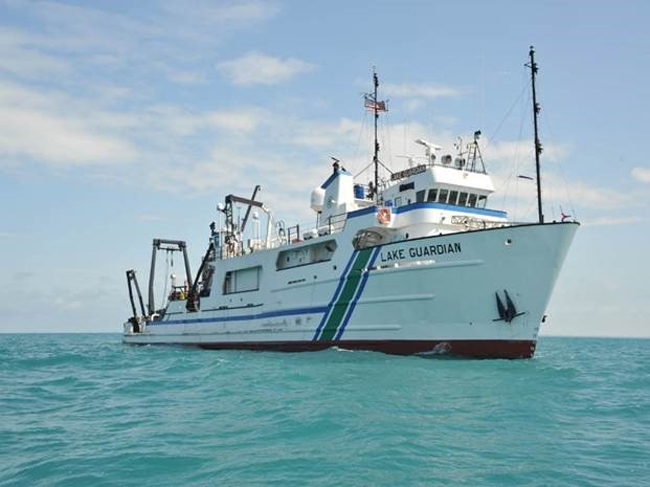
EPA R/V Lake Guardian. Credit: Michael Milligan
“The teachers who experience this unique Shipboard Science Immersion become ambassadors for the Great Lakes, extending their knowledge gain and their enthusiasm for environmental stewardship of all water resources to their students, colleagues, and communities,” said New York Sea Grant Great Lakes Literacy Specialist Nate Drag.
Drag coordinates the Lake Ontario Shipboard Science Immersion teacher expeditions. The Lake Guardian returns to Lake Ontario on its five-year rotation schedule in 2028. In the meantime, New York Sea Grant provides continuing professional development opportunities for teachers throughout New York State. Summer 2025 workshops will be held in Buffalo, Oswego, and Rochester. Contact Drag at nwd4@cornell.edu for details.
The Shipboard Science Immersions are designed to promote Great Lakes science while forging lasting relationships between Great Lakes researchers and educators. CGLL is a collaborative effort led by Sea Grant educators throughout the U.S. Great Lakes watershed. CGLL fosters informed and responsible decisions that advance basin-wide stewardship by providing hands-on experiences, educational resources, and networking opportunities promoting Great Lakes literacy among an engaged community of teachers, scientists, and youth.
More Info: 15 Educators Chosen to Join Sea Grant Aboard EPA’s Research Vessel on Lake Michigan
Fifteen educators from across the Great Lakes region — 4 from Illinois and Indiana; 3 each from Wisconsin and Ohio; 2 each from Michigan and New York; and 1 from Pennsylvania — have been selected to join Center for Great Lakes Literacy (CGLL) staff and Great Lakes scientists aboard a U.S. Environmental Protection Agency research vessel (R/V) this summer to study Lake Michigan and bring Great Lakes science and stewardship back to their classrooms and communities. The Shipboard Science Immersion will take place July 7–13, 2025.
The selected educators are:
• Eric Parr of Pike High School (IN)
• Gerard Kovach of Decatur Classical School, CPS (IL)
• Ryan Johnson of Jovita Idár Elementary School, CPS (IL)
• Amy Truemper of Bednarcik Junior High School (IL)
• Deann Smith of Ashley Community Schools (MI)
• Erika Van Kirk of U.S. Fish & Wildlife Service (MI)
• Jennifer Crane of Big Picture Ellicottville (NY)
• Beth Tucker of Tully Jr./Sr. High School (NY)
• Teresa Ballou of Westerville North High School (OH)
• Ann Gasser of Laurel School, Butler Campus (OH)
• Andrew Larsen of Penta Career Center (OH)
• Virginia Friedman of Abington Friends School (PA)
• Robert Fish of UW–Green Bay (WI)
• Jamie Lauer of Hartford Union High School (WI)
• Alina Prahl of Riveredge Nature Center (WI)
Through a partnership with the EPA Great Lakes National Program Office, NOAA, and with funding from the Great Lakes Restoration Initiative, educators will spend a full week alongside researchers aboard the EPA R/V Lake Guardian. Hosts for the Lake Michigan expedition are CGLL partners Illinois-Indiana Sea Grant and Wisconsin Sea Grant.
The Shipboard Science Immersions are designed to promote Great Lakes sciences while forging lasting relationships between Great Lakes researchers and educators. CGLL is a collaborative effort led by Sea Grant educators throughout the U.S. Great Lakes watershed. CGLL fosters informed and responsible decisions that advance basin-wide stewardship by providing hands-on experiences, educational resources, and networking opportunities promoting Great Lakes literacy among an engaged community of educators, scientists, and youth.
For more information on the Shipboard Science Immersion program and future opportunities, visit the Center for Great Lakes Literacy website at https://cgll.org.
More Info: New York Sea Grant
Established in 1966, the National Oceanic and Atmospheric Administration (NOAA)’s National Sea Grant College Program promotes the informed stewardship of coastal resources in 34 joint federal/state university-based programs in every U.S. coastal state (marine and Great Lakes) and Puerto Rico. The Sea Grant model has also inspired similar projects in the Pacific region, Korea and Indonesia.
Since 1971, New York Sea Grant (NYSG) has represented a statewide network of integrated research, education and extension services promoting coastal community economic vitality, environmental sustainability and citizen awareness and understanding about the State’s marine and Great Lakes resources.
NYSG historically leverages on average a 3 to 6-fold return on each invested federal dollar, annually. We benefit from this, as these resources are invested in Sea Grant staff and their work in communities right here in New York.
Through NYSG’s efforts, the combined talents of university scientists and extension specialists help develop and transfer science-based information to many coastal user groups—businesses and industries, federal, state and local government decision-makers and agency managers, educators, the media and the interested public.
New York Sea Grant, one of the largest of the state Sea Grant programs, is a cooperative program of the State University of New York (SUNY) and Cornell University. The program maintains Great Lakes offices at Cornell University, SUNY Buffalo, Rochester Institute of Technology, SUNY Oswego, the Wayne County Cooperative Extension office in Newark, and in Watertown. In the State's marine waters, NYSG has offices at Stony Brook University and with Cornell Cooperative Extension of Nassau County on Long Island, in Queens, at Brooklyn College, with Cornell Cooperative Extension in NYC, in Bronx, with Cornell Cooperative Extension of Ulster County in Kingston, and with Cornell Cooperative Extension of Westchester County in Elmsford.
For updates on Sea Grant activities: www.nyseagrant.org, follow us on social media (Facebook, Twitter/X, Instagram, Bluesky, LinkedIn, and YouTube). NYSG offers a free e-list sign up via www.nyseagrant.org/nycoastlines for its flagship publication, NY Coastlines/Currents, which it publishes 2-3 times a year.